


Читателям предлагается вторая часть обзора авторской методики преподавания английского языка. (Начало в №4 за 2012 г.)
Тема 1. Universal Rule of Plot-making
(the Victor Shklovsky Rule)
Contemplating about techniques which plot-makers (writers, poets) use, Victor Shklovsky points out the following general observation:
Any work of art or literature is made as a reflection of a certain standard model.
The author uses a classic standard as a starting point for a new work and a new plot. The public can discern the classic standard inside his new work and they view this new work in the light of associations.1
Several illustrations to this rule can be found below.
Example 1
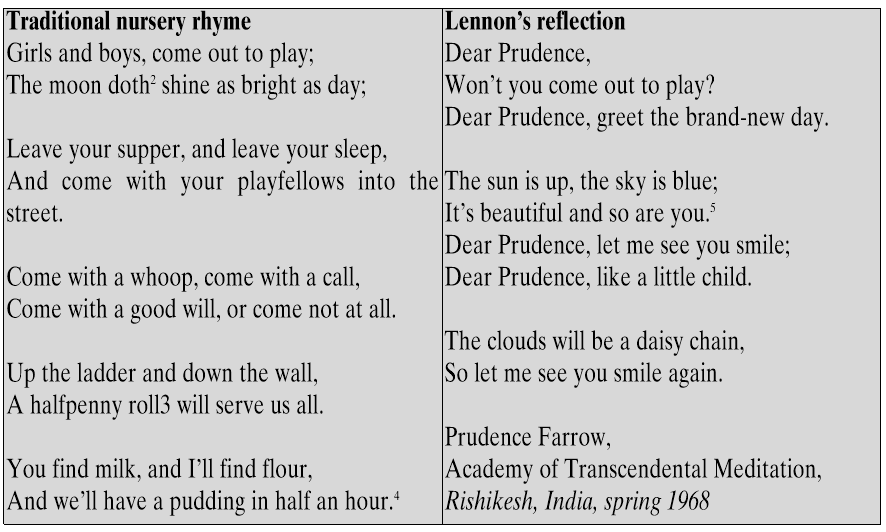
The Beatles — Mother Goose Nursery Rhymes
a). Dear Prudence
John Lennon: «Mia Farrow’s sister, Prudence, who seemed to go slightly balmy, meditating too long, wouldn’t come out of the little hut we were living in. They selected me and George to try and bring her out because she would trust us».
Paul McCartney: «Prudence Farrow got an attack of the horrors and paranoia, and wouldn’t come out of her chalet. We all got a little bit worried about her so we went up there and knocked. “Hi Prudence, we all love you. You’re wonderful”. But nobody could persuade her out. So John wrote, “Dear Prudence, won’t you come out and play”… He went in and sang it to her. I think that actually did help. John sang it outside her door with his guitar. And she looked out, she improved after that. It was a turning point».
Barry Miles: «Prudence has no memory of ever hearing the song in India, but she was in a semi-catatonic state from almost continuous meditation, against the Maharishi’s wishes, and didn’t even recognize her own brother at the time, so her memory is probably faulty».6
Catatonic (of a person) stiff and not moving, as if dead.7
Chalet /’ʃæleɪ, ʃæ’leɪ/8, a small wooden house found in mountainous areas, especially in Switzerland, or a house built in a similar style to be used by people on a holiday9; в некоторых зарубежных странах небольшой загородный дом, дача.10
Go balmy, slang expression, go off one’s head.11
Whoop /hwuːp, huːp/, a loud excited shout.12
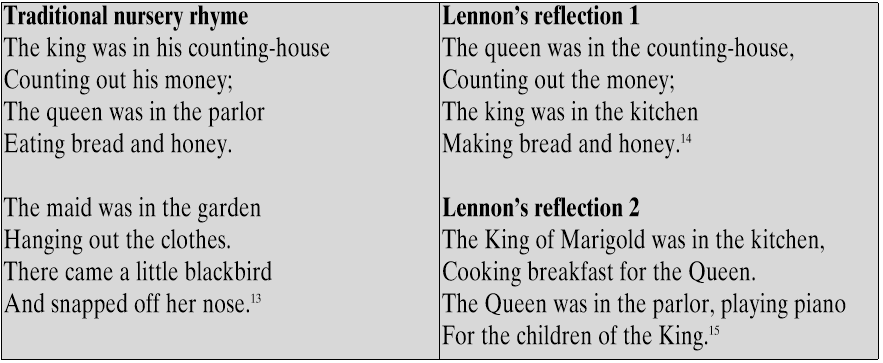
b). Cry Baby Cry / Clean Up Time
Sean /ʃɔːn, ʃɑːn /16 Lennon gave John renewed hope; here was a tiny mortal through whom he could recreate his own life, and soothe all the hurt of his own childhood. John woke up each morning at six to get the household chores started and to fix Sean and Yoko’s breakfast. He cared for the baby all day.
As John started to learn how to bake bread, Yoko gravitated to the business end of things. She made a series of profitable investments. She began buying homes in Japan, Oyster Bay, Long Island and Palm Beach. She purchased a farm in the Catskill Mountains in New York, and she also invested in cattle, and one of their cows sold on the auction block for a quarter of million dollars.17
c). Blackbird
(Traditional nursery rhyme)
Sing a song of sixpence,
A pocket full of rye;
Four and twenty blackbirds
Baked in a pie.
When the pie was open’d,
The birds began to sing;
Was not that a dainty dish
To set before the king?18
Blackbird
(Paul McCartney’s reflection)
Blackbird singing in the dead of night,
Take these sunken eyes and learn to see;
All your life you were only waiting
For this moment to be free.
Blackbird singing in the dead of night,
Take these broken wings and learn to fly;
All your life you were only waiting
For this moment to arise.19
Paul McCartney: «I had in mind a black woman, rather than a bird. Those were the days of civil-rights movement, so this was really a song from me to a black woman, experiencing these problems in the States: “Let me encourage you to keep trying, to keep your faith, there is hope”.
As is often the case with my things, a veiling took place. So rather than say “Black woman living in Little Rock” I made her a bird, and it became symbolic, so you could apply it to your particular problem».20
Blackbird, European songbird21; чёрный дрозд (Turdus merula)22; turdus, лат. дрозд; merula, лат. чёрный дрозд. The word “merula” became a symbol of blackness, and Romans coined a derivative after it — the adjective “meruleus” which has the meaning “black as a blackbird”.23
Dead of night, the middle of the night when it is extremely dark.24
Veiling, veiled, a veiled statement is one which is not expressed clearly25 (завуалированный).
d). Lady Madonna
Paul McCartney as a child
Wednesday’s bairn is full of woe
John Lennon was born on Wednesday29, 9 October 1940.
Reminiscences about his childhood were always filled with unconsolable guilt. It was the rejection he remembered most, the feeling that he was in the way, a source of Julia’s unhappiness and Freddie’s absenteeism. «The worst pain is that of not being wanted», John confessed, «of realizing your parents do not need you…»30
The grown-up Lennon immortalized the pain of not being wanted in the song below.
Yer Blues31
(John Lennon)
Yes, I’m lonely! Wanna die!
Yes, I’m lonely! Wanna die!
If I ain’t dead already, ooh!
Girl, you know the reason why.
In the morning wanna die!
In the evening wanna die!
If I ain’t dead already, ooh!
Girl, you know the reason why.
My mother was of the sky.
My father was of the earth.
But I am of the Universe,
And you know what it’s worth.
The eagle picks my eye.
The worm, he licks my bone.
Feel so suicidal!
Just like Dylan’s Mr. Jones.
Black cloud crossed my mind.
Blue mist round my soul.
Feel so suicidal!
Even hate my Rock and Roll.
The bairn that is born on the Sabbath Day
Richie Starkey was born on Sunday32 / “Sabbath Day”, 7 July 1940.
But the bairn that is born on the Sabbath day
Is bonny and blithe, and good and gay.
Class teacher’s remark:
A quiet thoughtful type, although working rather slowly. Academic work will no doubt improve in time so he is trying to do his best. Helpful and willing.
Ringo’s happy-go-lucky lifestyle was there all along and sung in the guide below.
Step Lightly33
Step lightly
Things will work out fine,
Nice and easy.
All it takes is time.
Please believe me.
I wish this song was yours instead of mine.
Thursday’s bairn has far to go
Paul McCartney was born on Thursday34, 18 June 1942.
Bairn /bɛən/, Scottish English or regional, a child.35
To the ear of the British of South England, this vernacular word probably sounds like the Ukrainian word ‘дитына’, ‘дитынька’ sounds to the Russian ear.
Blithe, dated, happy and without worry36, счастливый и беспечный; блаженный.
Bonny, especially Scottish English, beautiful and healthy.
- What a bonny lass she is!37
To the ear of the British of South England, this piece of vernacular probably sounds like the Ukrainian words ‘гарна дивчина’ sound to the ear of the Russians.
Sabbath, the day of the week kept by some religious groups for rest and worship (Sunday for most Christians, Saturday for Jews and Friday for Muslims). - We always observed the Sabbath, when I was a child.
- My Grandmother never broke the Sabbath.38
Example 2
The Yellow Submarine — Coleridge’ Ancient Mariner
Paul McCartney: «I was laying in bed in the Asher’s garret, and there’s a nice twilight zone just as you’re drifting into sleep, quite a comfortable zone — you’ve laid your burdens down for the day and there’s this little limbo-land just before you slip into sleep. I remember thinking that a children’s song would be quite a good idea and I thought of images. And the color yellow came to me, and a submarine came to me. I was thinking of it as a song for Ringo, so I just made up a little tune in my head, then started making a story, sort of an ancient mariner, telling the young kids where he’d lived and had had a yellow submarine. There were funny little grammatical jokes we used to play. It should have been: “Everyone of us has all he needs’ but Ringo turned it into: ‘Everyone of us has all we need”. It’s wrong but it’s great. We used to love that».39
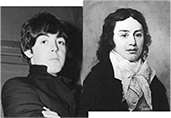
Paul McCartney (left), Samuel Coleridge, 1772–1834 (right)
In transitu: Paul McCartney’s report about the Beatles’ finding pleasure in grammatical mistakes makes us recall Alexander Pushkin who made a similar statement:
Как уст румяных без улыбки,
Без грамматической ошибки
Я русской речи не люблю.40
Paul McCartney makes a mistake in the fragment above. It should have been “I was lying in bed”, while “lay” is all right if it would have been “I lay in bed”. These forms are not to be confused:
to lie — lay (past indefinite) — lying (participle I); лежать.
to lay — laid (past indefinite) — laying (participle I); класть.
John Lennon: «A dentist in London laid it on George, me and our wives without telling us at a dinner party at his house. He just put it in our coffee or something. I was suddenly struck by great visions. Well, it seemed to go on all night. I did a lot of drawing that night. I gave them to Ringo, the originals. And the guys all went to bed. And then George’s house seemed to be just like a big submarine. It seemed to float above his wall, which was eighteen foot, and I was driving it».41
Miles: «Paul often dropped in on Donovan, since he and his flatmate Gypsy Dave lived nearby, and Donovan recalls that he helped out on a lyric that was in an unfinished state.
“Paul [MCartney] played a tune about a Yellow Submarine. He said he was missing a line and would I fill it in. I left the room and returned with this:
sky of blue and sea of green
in our yellow submarine.
It was nothing really, but he liked it and it stayed in.”
Once the backing track was down, another session was arranged to add the sound effects. George Martin had made his name producing comedy records with the Goons and Peter Sellers, and sound effects were one of his specialities. The Beatles driver rattled old chains while the Rolling Stone Brian Jones tapped his glass. John blew bubbles through a straw in a bucket of water, and he and Paul improvised Goonish nonsense, “Full stern ahead, Mr. Bosun”».42
The classical version, that is Take 5, was recorded on June 1, 1966. In a later remix, the sound of marching feet is heard while Ringo recites the following verse:
Yellow submarine.
And we will march to free the day,
To see them gathered there,
From Land O’ Groats to John O’ Green,
From Stepney to Utrecht,
To see a yellow submarine.43
We love it!
One can hear a curious little phrase in the middle of the song (timing is as follows — 1:49-1:50). It is pure Russian, and it says, «Русские высадили десант» (“A Russian landing force is on our soil”).
Land’s End is the extreme southwest point of Great Britain, situated in western Cornwall at the end of the Penwith peninsula.
John o’Groats is the extreme northern point of mainland Scotland.44
So the Beatles did “the Goonish nonsense”. Now what is it, Goonish nonsense? The Goons (“Балбесы”) was a group of British comedians who made a BBC radio program, which was broadcast from 1951 to 1960. The first series, broadcast between May and September 1951, was titled “Crazy People”. All subsequent series had the title “The Goon Show”. The Goons mixed ludicrous plots with surreal humour, puns, catchphrases and an array of bizarre sound effects. Electronic effects were devised by the then-fledgling BBC Radiophonic Workshop. Other shows used some for decades afterwards. The Goons made a parody of contemporary life in Britain and they had a big influence on the British and American comedy as well as popular culture. The Beatles acknowledged their respect for the Goons.45
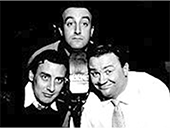
The Goons, or Spike Milligan (left), Peter Sellers (top), Harry Secombe (right)
Yellow Submarine46
(McCartney & Lennon)
In the town
where I was born
lived a man
who sailed the sea.
And he told
us of his life
in the land
of submarines.
So we sailed on
to the sun
till we found
the sea of green.
And we lived
beneath the waves
in our yellow
submarine.
And our friends
are all aboard,
many more of them.
Live next door.
And the band
begins to play.
As we live
a life of ease,
everyone of us
has all we need —
sky of blue
and sea of green
in our yellow
submarine.
The Rhyme of the Ancient Mariner (1798)
And I had done
a hellish thing,
And it would work ‘em woe:
For all averred,
I had killed the bird
That made the breeze to blow.
The fair breeze blew;
The white foam flew;
The furrow followed free;
We were the first
That ever burst
Into that silent sea.
Day after day,
Day after day
We stuck nor breath, nor motion
As idle as
a painted ship
Upon the painted ocean.
Water, water, everywhere,
And all the boards did shrink;
Water, water, everywhere,
Nor any drop to drink.
And every tongue, through utter drought,
Was withered at the root;
We could not speak, no more than if
We had been choked with soot.
Ah! Well-a-day! What evil looks
Had I from old and young!
Instead of the cross, the Albatross
Around my neck was hung.
Древний мореход
И я совершил нечестивый поступок, и это принесёт им несчастье. Ведь все заявили, что я убил птицу, которая принесла с собой ветер.
Дул попутный ветер, летела белая пена, вслед за кормой вольно тянулся кильватер. Мы были первыми людьми, которые когда-либо вторгались в это безмолвное море.
День за днём, день за днём мы стояли на одном месте, ни дуновения, ни движения, такие же недвижные, как нарисованный корабль на нарисованном океане.
Вода, везде вода, но борта корабля пересохли. Вода, везде вода, но ни капли питьевой.
От страшной жажды язык каждого моряка засох у корня. Мы не могли вымолвить ни слова, как будто бы горло забила сажа.
Увы! О горе! Какие недобрые взгляды бросал на меня и стар и млад. Вместо креста мне на шею повесили убитого альбатроса.
Example 3
The Beatles’ Rain — the Kinks’ Rainy Day in June
Rain
Lennon (& McCartney)
If the rain comes,
They run and hide their heads.
They might as well be dead.
If the rain comes —
If the rain comes —
When the sun shines,
They slip into the shade
And sip their lemonade.
When the sun shines —
When the sun shines —
I can show you
That when it starts to rain,
Everything’s the same.
I can show you —
I can show you —
Rain — I don’t mind.
Shine — the weather’s fine.
Can you hear me
That when it rains and shines,
It’s just a state of mind?
Can you hear me?
Can you hear me?
Paul McCartney: “Songs have traditionally treated rain as a bad thing. What we got on to was that the rain is no bad thing. There’s no greater feeling than the raindrops dripping down your back.”52
Later on, the Maestro would sing what could be called an ode to rain:
The rain comes falling from the sky
To fill the stream that fills the sea
And that’s where life began for you and me.
So the next time you see rain,
it ain’t bad.
Don’t complain.
It rains for you.
So lay down your umbrellas,
Strip off your plastic macs.
You’ve never felt the rain, my friend,
Till you’ve felt it running down your back.53
[The sound was made contrarily to the lyric.] When recording “Rain”, the Beatles played the backing track faster than normal and then slowed the whole thing down. It made the bass very low and the drums very heavy.
Paul McCartney: “If you slow down a footstep, it becomes a giant’s footstep. So the drums became a giant drum kit. Now we got a big, ponderous, thunderous backing and then we worked on top of that as normal. It made the whole thing sound ominous.”
Paul McCartney’s Rainy Day
(Chiswick House, London, 20 May, 1966)
«This day, the Beatles and their retinues descended upon the beautiful early 18th-century gardens of Chiswick House in West London. Their object was to film promo clips for ‘Paperback Writer’ and ‘Rain’. It is worth noting that Paul looked facially different in all of the promos: he had a chipped front-top tooth, the result of a mo-ped accident».54
Anthology (part 5): The Chipped-Tooth Shots
Rainy Day in June55
A misty shadow spread its wings
And covered all the ground.
And even though the sun was out,
The rain came pouring down.
And all the light had disappeared
And faded in the gloom.
There was no hope, no reasoning
This rainy day in June.
The eagle spread its mighty wings
And pounced upon its prey.
And all the skies so brilliant blue
Turned suddenly to grey.
The cherished things are perishing
And buried in their tomb.
There is no hope, no reasoning
This rainy day in June.
And everybody felt the rain.
Everybody felt the rain.
The demon stretched its crinkled hand
And snatched a butterfly.
The elves and gnomes were hunched in fear,
Too terrified to cry.
The reckoning was beckoning.
They’re living to their doom.
There was no hope, no reasoning
This rainy day in June.
Тот июньский день, когда хлынул дождь
Неясная тень расправила крылья и покрыла собой всю землю.
И хотя на небе сияло солнце, хлынул проливной дождь.
И свет погас и растворился во мраке.
И не было никакой надежды, и напрасны были разумные доводы
В тот июньский день, когда хлынул проливной дождь.
Орёл расправил свои могучие крылья и устремился вниз на свою жертву.
И всё небо, только что сиявшее голубизной, внезапно сделалось серым.
Гибнет всё, что ты ценишь, погребённое в этом склепе.
И нет никакой надежды, и напрасны разумные доводы
В этот июньский день, когда хлынул проливной дождь.
Демон протянул сморщенную длань и изловил бабочку.
Эльфы и гномы сгорбились в страхе, не смея плакать от ужаса.
Расплата манила к себе кивком пальца, и жизнь их близилась к тому, что им назначил рок.
И не было никакой надежды, и напрасны были разумные доводы в тот июньский день, когда хлынул проливной дождь.
И каждый ощутил на себе дождь; каждый ощутил на себе дождь.
Iambic Tetrameters in Rock and Classics
“Rainy Day in June” is a verse in iambic tetrameters, as is “The Ancient Mariner”, a narrative poem by Coleridge.56 Iambic tetrameters also make Pushkin’s narrative poem “Yevgeny Onegin”:
The de-mon stretched its crink-led hand
And snatched a but-ter-fly.
The elves and gnomes were hunched
in fear, Ray Davies
Too ter-ri-fied to cry.
Day af-ter day, day af-ter day
We stuck nor breath, nor mo-tion
As i-dle as a pain-ted ship Coleridge
U-pon the pain-ted o-cean.
И снит-ся чуд-ный сон Та-тья-не.
Ей снит-ся буд-то бы о-на
И-дёт по сне-го-вой по-ля-не. Pushkin
Пе-чаль-ной мглой о-кру-же-на.
Тема 2. Up the Smoke.
“Swinging London”57
The Beatles entered the Cavern Club as virtually unknown teddy boys and came out with a number-one single and a number-one album. However, in order to keep up the momentum they had to take on London. They were ready to go “up the Smoke”.
Paul: «I had this strange entrance into London, coming down from Liverpool where everyone had said, “You’ll never make it, coming from Liverpool” which had angered us a bit, so we stayed up in Liverpool a lot. We didn’t just all move down to London. We tried to prove ourselves from Liverpool. Hamburg, Liverpool, the north — you know, “Fuck you!” And we had our original success up in the Cavern. But this got us national success and then came the inevitable move to London».
The Beatles arrived just as the sixties were getting into gear. In 1963, the Christine Keeler — John Profumo affair would bring thirteen years of Tory rule to an end, though Sir Alec Douglas-Home, dragged in from the grouse moors in his tweeds, almost won the election after Harold MacMillan resigned. No more “Mustn’t grumble”, no more “Grin and bear it”. The era of the spiv and the wide boy was back. All manner of East End barrow boys and public-school failures emerged with an eye for the main chance. Get-rich-quick schemes bloomed. Everything modern was ‘in’. Everything and everyone old was out. The entire city was up for grabs, including people and buildings.
Paul: «This working-class explosion was all happening and we were very much a part of it. Making it okay to be common. The East End photographers, the working-class actors… So now we were the wacky chappies from up north. I think we had a lot to do with it».
London of 1963 was still pitted with overgrown bomb sites, though many of the best sites were under development. The look of the city was undergoing massive changes. The pastoral horizon of Hyde Park was broken first by the London Hilton tower in 1962, then by the Lancaster Gate Hotel. Both exceptions [were] made to the London planning regulations ‘in order to attract American visitors’, who were presumably unable to stay in low buildings. The Post Office Tower rose slowly above the rooftops of Bloomsbury to become the tallest building in London. Centre Point, a banal copy of a second-rate original by Marcel Breuer built for Harry Hyams on the site of the medieval village of St Giles, was fitted together like a giant Lego set before standing empty for years.
Comments to “Up the Smoke”
Barrow truck
Barrow (1) = wheelbarrow, a movable container with a wheel at the front and two handles at the back, used especially in the garden for carrying things around.
- I saw the gardener pushing a wheelbarrow full of bulbs round the back of the house.58
Barrow (2), a vehicle (a machine usually with wheels and an engine which is used for transporting people or goods on roads59) from which goods, especially fruit and vegetables are sold at the side of the road.60
Desmond has a barrow in the marketplace.
Molly is the singer in a band.
Desmond says to Molly: “Girl, I like your face.”
And Molly says this as she takes him by the hand:
“Ob-la-di, ob-la-da!61
Life goes on, bra!
La-la! How the life goes on!”62
Интересно сравнить переосмысленный английский апеллятив с жаргонным термином, бытующим в русском языке: тачка, легковая автомашина. - Там уже стоял роскошный иностранный автомобиль. — Какая тачка! — восхитился Арон.63
Barrow boy, a man who sells goods, especially fruit and vegetables from a barrow.64
The Barrow Boy singer & his “ob-la-di ob-la-da”
Down (1) towards a lower position or level.
- Be nice to people on your way up because you’ll meet them on your way down.
Down (2) in the south. - Things are much more expensive down south.65
- Way down South they had a jubilee.
The old folks, they had a jamboree
And, drinkin’ home brew from a wooden cup,
Began to dance till they were all shook up.66
Down (3) towards the south. - How often do you come down to Louisiana?67
- Gear /gɪə/ [1963], wonderful, excellent, good; a traditional piece of Liverpudlian vocabulary, brought into the mainstream by the Beatles popularity.
- They enlarged the English language, bringing Liverpool words like ‘gear’ (meaning good or great) into general usage (Hunter Davies. The Beatles. 1968).68
Grab, take hold of something suddenly and roughly. - A mugger grabbed her handbag as she was walking across the park.70
Found my coat and grabbed my hat,
Made the bus in seconds flat.
Found my way upstairs and had a smoke.
Somebody spoke
And I went into a dream.71
Grouse moors (see below):
•Grouse /graʊs/, or moor fowl /’mʊə,faʊl/, reddish game-bird of the British Isles.72 - Moors, moorland, open hilly countryside covered with grass, small bushes and heather.73
In, informal, fashionable or popular. - High heels are in this season.
- Music like that has not been in for ages.
- The new rock club seems to be the in place to go at the moment.74
Make it, achieve a success in some activity75; overcome difficulties.76
- You’ll never make it, coming from Liverpool.
- Oh, darling, if you leave me, I’ll never make it alone.77
Public school (1) in England, a private school paid for by parents not the government at which girls aged from 11 to 18 and boys aged from 13 to 18 usually live while they study.
In September 1952, John Lennon entered for the first time the imposing circular lobby of Quarry Bank Grammar School. Academically Quarry Bank was a first-rate school, particularly strong in the humanities. It was closely modeled on those citadels of privilege, the ancient British public schools, and after it had produced a couple of Socialist Prime Ministers, the press dubbed it the “Eton of the Labour Party”. Though the pupils lived at home, they were organized, as in residence schools, into houses. There were prefects to enforce discipline, and canings were administered by the black-gowned headmaster, who kept a record of every infraction in his punishment book.78
Quarry Bank High School — a Grammar School — was founded in 1922. Its first headmaster was called George Harrison. Former pupils of the school include labour government ministers William Rodgers and Peter Shore.
The school uniform included a black blazer with red and gold stags-head badge which sported the motto “Ex Hoc Metallo Virtutem” — “From This Rough Metal We Forge Virtue”.
John Lennon became a pupil at Quarry Bank in September 1952, and the twelve-year-old boy would ride the bike there each morning from his Menlove Avenue home one mile away. The school headmaster found that he had a couple of troublemakers on his hands in the form of Lennon and his mate Pete Shotton.
The pair were very disruptive, were always causing trouble at the school, and they were often disciplined by caning and by detention. Academically John and Pete were uninterested in studying and both were placed at the bottom of the “C” stream where they remained for most of their school lives. When John took his GCE “O” Level examinations he failed in every subject!79
Public school (2) in Scotland, Australia and the US, a free school provided by the government.80
The situation with the “public school” term reveals the fact that potentially the same phrase may have opposite meanings in different parts of the English-speaking world. In transitu, the English-speaking world includes United Kingdom, USA, Australia, Canada, New Zealand. Each of these parts is a combination of smaller linguistic territories, like UK is divided into England, Scotland, Northern Ireland, Wales, Cornwall, Shetland Islands.
Up the smoke, informal, towards the centre of on-going cultural and social events (в центр событий; туда, где жизнь бьёт ключом, где происходит всё самое важное).
Smoke (the), informal, any large city, especially as compared with countryside.
- He was a naïve young lad of 16 when he first came to the smoke to look for work.81
Up, towards a more important place, especially a city. - What time does the next up train leave? (train going to an important place such as a capital city)82
Salzburg (Austria), the Castle
It can be surmised that the meaning above is inspired by the archetypical notion of the acropolis as a centre of social life for a big group of people in which important decisions are made and important events held. Since the earliest times, an acropolis was the seat of important institutions, like residence of the supreme ruler, temple complexes, food stores of strategic significance, etc.
The picture shows the Rock of Cashel which was the traditional seat of the kings of Munster for several hundred years prior to the Norman invasion.83
Acropolis /ə’krɒpəlɪs/, the “city on the top”. For purposes of defence, early people naturally chose elevated ground to build a new settlement, frequently a hill with precipitous sides. In many parts of the world, these early citadels became the nuclei of large cities, which grew up on the surrounding lower ground. The acropolis model is typical for a lot of cities like Athens, Argos, Thebes, Corinth, Rome, Jerusalem, Bratislava, Prague, Budapest, Rock of Cashel in Ireland, etc. In central Italy, many small rural communes still cluster at the base of a fortified habitation known as “La Rocca” of the commune. Castle Rock in Edinburgh is another example of the acropolis model.85 - There’s room at the top they’re telling you still,
But first you must learn how to smile as you kill,
If you want to be like the folks on the hill.86
John Lennon at the time of writing the verse above
Spiv, slang, a particular type of petty criminal, usually smartly-dressed, making money by various schemes in black market goods, and having a good time. The term was particularly used during the World War II and in the post-war rationing period. Immediately after the Second World War, the comedian Arthur English set the popular image of a spiv — a man with a pencil moustache, wearing a wide-brimmed hat, light-coloured suit and a bright patterned tie.87 In the 1970–80s USSR, this kind of men was called “fartsovshchiki”88; жарг. спекулянт, фарцовщик; тёмная личность.89
- Handsome and well built, John Dykins, Julia’s common-law husband, had an exotic air owing to his dark “Spanish” complexion and pencil-line movie-star moustache. The Stanleys called him “Spiv”, which connotes the slick black-market operator.90
Swinging, exciting and fashionable. - It’s a nostalgia trip back into the youth culture of the swinging 1960s.91
Swinging London, the term «swinging» in the sense of hip or fashionable, had been used since the early 1960s, and in mid-sixties was applied to London, the place “where it’s at”.92 - It was June 1966 and the world exploded around the Beatles and fragmented into the seeds of tangerine trees and marmalade skies; London was the best place on earth and they were the best people to be. Yet they had to do the one thing they wanted to do the least — leave their paradise on tour.93
Take on, to conquer, to win, to subdue. - I’ll take you on in the next fist-fighting, big bad bulldog.94
Teddy boys, British teenagers and youngsters in the 1950s, who typically dressed in clothes inspired by the style of the Edwardian period (1902–1910).95 Teds’ clothing was narrow “drainpipe” trousers, long drape jackets and shoes with thick crepe soles, often suede. Teds had fancy hairstyles — long, strongly-moulded greased-up hair with a quiff at the front.
The hair at the sides was combed back to form the so-called duck’s arse or DA at the rear. The subculture started in London and rapidly spread across the UK. Teddy Boys were notorious for the violent lifestyle, so they were originally called cosh boys (a cosh being a short heavy piece of pipe used as a weapon, especially for hitting someone on their head96). In 1953, “Daily Express” newspaper coined another name we know them by. The British affectionately called King Edward VII “Teddy” which is a diminutive of Edward, so the first youth group in England to differentiate themselves as “teenagers”, thus helping to create a youth market, was named after Edward VII. Teds soon became associated with American Rock and Roll music.97 - Around six o’clock on the afternoon of 6 July 1957, Mimi Smith was taking tea in the refreshment tent when a strange jangling noise reached her ears. Looking out to see what was afoot, Mimi was horrified to behold her John standing in front of the microphone, guitar in hand, wearing a loud checkerboard shirt, “A real Teddy Boy!”98
Tweeds, clothes made from tweed, especially a jacket and matching trousers. - He is a man with a penchant for thick tweeds and British country style.
- Tweedy, refers to the life of wealthy people with homes in the countryside and an interest in hunting.99
Tweed, the River that divides Scotland from England. Near it is the manor of the Home family, the Hirsel. - The Hirsel is home of the Homes.
Up (1) указывает на изменение положения из горизонтального в вертикальное.100
- The whole city was up for grabs, including people and buildings.
Up (2) So as to be equal in quality or achievement101, на прежнем уровне. - The weather keeps up / Погода остаётся прежней.102
- To keep up the momentum, they had to take on London.
Up (3) towards the north (down — towards the south). - She comes up from Washington about once a month on the train.103
•She’ll be travelling up to Newcastle from Birmingham.104
“Up” and “down” as “North” and “South” in the earliest times:
GENESIS105. A fragment (Illustrations taken from the Images of Abram site106)
«And Abram /’eɪbrəm/107 took Sarai /’sɛərɑːɪ/108 his wife, and Lot his brother’s son, and all their possessions which they had gathered, and the persons they had gotten in Haran /’hɛərən/109, and they set forth to go to the land of Canaan /’keɪnən/.110
Abram passed through the land to the oak of Moreh /’moʊrɪ/.111 At that time the Canaanites /’keɪnənaɪts/112 were in the land. Then the Lord appeared to Abram, and said, “To your descendants I will give this land.” So Abram built there an altar to the Lord.
Now there was a famine in the land. So Abram went down to Egypt to sojourn there, for the famine was severe in the land.
When Abram was about to enter Egypt, he said to Sarai his wife, “I know that you are a woman beautiful to behold; and when the Egyptians see you, they will say, “This is his wife”; then they will kill me, but they will let you live. Say you are my sister that it may go well with me because of you…
When Abram entered Egypt, the Egyptians saw that the woman was very beautiful. And when the princes of Pharaoh saw her, they praised her to Pharaoh. And the woman was taken into Pharaoh’s house. And for her sake he dealt well with Abram; and Abram had sheep, oxen, he-asses, menservants, maidservants, she-asses, and camels…
…So Abram went up from Egypt, he and his wife, and all that he had, and Lot with him, into the Negeb /’negəb/.113 Now Abram was very rich in cattle, in silver, and in gold».114
Книга БЫТИЯ. Отрывок
«И взял Аврам с собою Сару, жену свою, Лота, сына брата своего, и всё имение, которое они приобрели, и всех людей, которых они приобрели в Харране, и вышли, чтобы идти в земпю Ханаанскую. И прошёл Аврам по земле сей (по длине её) до дубравы Море. В этой земле жили тогда ханаанеи. И явился Господь Авраму и сказал ему: потомству твоему отдам Я землю сию. И создал там Аврам жертвенник Господу…
И был голод в той стране. И сошёл (спустился) Аврам в Египет, пожить там, потому что усилился голод в земле той. Когда же он приближался к Египту, то сказал Саре, жене своей: “Вот, я знаю, что ты женщина, прекрасная видом; и когда египтяне увидят тебя, то скажут: Это жена его; и убьют меня, тебя же оставят в живых. Скажи же, что ты мне сестра, дабы мне хорошо было ради тебя, и дабы жива была душа моя чрез тебя”.
И было, когда пришёл Аврам в Египет, египтяне увидели, что она женщина весьма красивая; увидели её и вельможи фараоновы похвалили её фараону; и взята была она в дом фараонов. И Авраму хорошо было ради неё; и был у него мелкий и крупный скот и ослы, и рабы и рабыни, и лошаки и верблюды…
…И поднялся Аврам из Египта, сам и жена его, и всё, что у него было, и Лот с ним, в Негеб. И был Аврам очень богат скотом, и серебром, и золотом».115
Where it’s at, informal, that which is at the forefront of on-going social undertakings116 (в самом центре наиважнейших событий):
- Tell me what you think about your friends at the top.
Who d’you think besides yourself’s the pick of the crop?
Buddha, was he where it’s at? Is he where you are?
Could Mahomet move a mountain or was that just PR?117
Wide boy, informal disapproving, a man who is dishonest or who deceives people in the way he does business.
- Some of the younger property developers are real wide boys.118
Would, выражает предположение, сомнение: - That would be him / Это, пожалуй, он.
- It would be in the year 1910 / Это было где-то в 1910 г.
- Who’s the man you want to speak to? — You would not know him /
А с кем именно ты хочешь поговорить? — Ты вряд ли его знаешь.119
Places, Buildings and People Mentioned in “Up the Smoke”
The Post Office Towernearly completed (as of 23 May 1964). The Post Office Tower completed
Bloomsbury Square
Bloomsbury, an area in Central London notable for its array of garden squares (Bloomsbury & Bedford Squares), a fashionable residential district and a home of many renowned institutions like the British Museum, the Royal Academy of Dramatic Art, the University of London’s colleges, etc. The name was first noted in 1201, when William de Blemond, a Norman baron, acquired the land and built the beri (manor house) in this area, hence the name — Blemondisberi > Bloomsbury.120
Oscar Wilde’s house, Tate Street, Chelsea
Chelsea /’chelsi/121, an area in Central London with a reputation of centre of innovation and influence. During the 19th century Chelsea became a Victorian artists’ colony. Pre-Raphaelite movement had its heart here. It was also home to many writers like Jonathan Swift, Oscar Wilde, Agatha Christie. Chelsea became prominent once again as one of the centres of 1960s “Swinging London”. All the Rolling Stones, Eric Clapton, and Mark Knopfler lived in Chelsea.122
Sir Alec Douglas-Home /,dʌgləs’ hju:m/123, the 14th Earl of Home, Prime Minister of the UK from October 1963 to October 1964.124 Home is also the name for the Homes’ manor house and a Scottish place-name. The etymology is “the one living by an island in a fen” (from northern Middle English holm, ‘island’. And it’s true — the Homes’ home is located by the Hirsel Lake. The name has several variants — Hume, Holme, Holmes.125
Harold Macmillan, the 1st Earl of Stockton, Prime Minister of the United Kingdom from January 1957 to October 1963. He ended the National Service in October 1963.126
John Dennis Profumo, the 5th Baron Profumo, a Brigadier & British politician, was involved in a 1963 scandal with a call-girl, Christine Keeler, resulting in his withdrawal from politics. Shortly after his resignation, he began to work as a volunteer cleaning toilets at Toynbee Hall, a house of social reform in which the rich and the poor live closely together as an interdependent community. He continued to work there until the end of his life (March 2006) — not as a toilet-cleaner, though. He was “persuaded to lay down his mop and lend a hand running the place.” He eventually became Toynbee Hall’s chief fundraiser. He got large sums of money using his political skills and contacts.127
Toynbee Hall, the first settlement house in England founded in 1884, named after Oxford historian Arnold Toynbee.
Titles of honour for persons of a high social rank in Britain given from father to son, except for the Knight (from the lowest to the highest):
- Knight is a man who is given a rank of honor by a British king or queen because of his special achievements, and who has the right to be called ‘Sir’.128
- He hopes to be made a knight for his work at the Bank of England.
- He was knighted by the Queen for his work for the hospital service.
- It came as little surprise that Paul’s name was down for a knight bachelor on the New Year Honours List released on December 31st, 1996.129
- Mr Thatcher was created a Baronet in 1990 and is now called Sir Denis Thatcher.
- Are you a friend of Baron Wendleton’s?
- The viscount, now aged 64, inherited his title at 15 while at Eton.
- Security is quite tight because several earls and a duke will be in the audience.
- The Marquis of Blandford is the son and heir of the Duke of Marlborough.
The Hyde Park gates (the list is incomplete):
Palace Gate,
Prince of Wales Gate,
Queen’s Gate,
Victoria Gate (after Queen Victoria),
Alexandra Gate (after Edward VII’s consort Alexandra),
Marlborough Gate (after Duke of Marlborough),
Grosvenor Gate (Grosvenor, the family name of a noble clan),
Lancaster Gate.
Туда, где происходит всё самое важное. Ультрамодный Лондон
Битлз вошли в клуб «Пещера» четырьмя практически никому не известными стилягами с хулиганскими замашками, а вышли из него с мини-диском и альбомом, которые заняли первое место в национальном списке популярности. Однако чтобы не потерять движущую силу первоначального успеха, они должны были завоевать Лондон. Они были готовы уехать в эпицентр событий.
Пол: «Я имел странное вхождение в Лондон, поскольку я приехал туда с севера, из Ливерпуля, где все говорили: “Вам не добиться успеха, как бы ни старались, ведь вы из Ливерпуля”. Что немного злило нас, так что мы проводили много времени на севере, в Ливерпуле. Никто из нас не переезжал на юг, в Лондон. Мы пытались проявить себя, находясь в Ливерпуле — в Ливерпуле, в Гамбурге, на севере, как бы говоря: “Да пошли вы все к чёрту!” На севере мы и добились своего первого успеха — на севере, в клубе “Пещера”. И всё же этот [региональный] успех открыл нам дорогу к всенародному успеху, а вслед за ним последовал и неизбежный переезд в Лондон».
Битлз появились в Лондоне именно в тот момент, когда 1960-е гг. набирали скорость.
В 1963 г. дело Джон Профьюмо — Кристин Киилер, как считается, положило конец 13-летнему правлению тори, хотя сэр Алек Дуглас-Хьюм, которого прямо в твидовом охотничьем облачении130 вытащили из вересковых пустошей, изобилующих куропатками, чуть было не одержал победу на выборах после того, как Гарольд МакМиллан подал в отставку.
Слова «Ворчать запрещается» и«Ухмыляйся и терпи» исчезли из обихода. Вернулась эра фарцовщиков и пронырливых мошенников. Пространство заполнилось торговцами из Ист-Энда, продававшими всевозможные товары с грузовичков, и всякого рода юнцами, провалившими экзамены в частные привилегированные школы. Весь этот люд стремился воспользоваться благоприятным моментом и не упустить свой шанс. Пышным цветом расцвели планы быстрого обогащения. Всё современное было в моде, всё старое было в загоне. Стремясь добыть большие деньги, весь город (как люди, так и здания) сменил горизонтальное положение на вертикальное.
Пол: «Пространство заполнилось всем, что было связано с рабочим классом, и мы были неотъемлемой частью этого явления. Быть простолюдином стало нормой жизни — фотографы из Ист-Энда, актёры из семей рабочих… В этом контексте и на нас смотрели как на забавных мальчуганов, приехавших в столицу из северной провинции. Я полагаю, в сознании людей мы были тесно связаны с этими переменами».
В 1963 г. Лондон был всё ещё покрыт ямами от разорвавшихся бомб, поросшими травой, однако лучшие территории города находились в стадии строительства. С Лондоном происходили радикальные перемены.
Пасторальный вид Гайд-парка был сначала нарушен башней «Лондонского Хилтона» (это произошло в 1962 г.), а затем отелем «Ланкастерские ворота». Для обоих зданий было сделано исключение в лондонском своде правил градостроения «с целью привлечения американских туристов», которые, как предполагалось, были неспособны жить в низких строениях.
Над крышами Блумсбери к небу медленно тянулась Почтовая башня, которая в конце концов стала самым высоким зданием Лондона.
Подобно гигантской игрушке конструктора «Лего», была собрана банальная копия второразрядного оригинала Марселя Бреера, воздвигнутая архитектором Ричардом Сейфертом по заказу Гарри Хайамса на территории средневековой деревушки Сент-Джайлз и годами стоявшая пустой — Точка центра.
Four Types of Tenses in English (Definitions, Examples)
Неопределенные — indefinite;
Длительные — continuous;
Предшествующие — perfect;
Предшествующие длительные — perfect continuous.
В данном отрывке из текста “Up the Smoke” всего 39 сказуемых, из них:
Длительные времена: 3
Предшествующие времена: 2
Предшествующие длительные: 0
Неопределённые времена: 34
Длительные времена выражают действие, длящееся в какой-либо определённый момент в настоящем, прошлом или будущем.
- As she’s getting ready to go, a knock comes on the door.131
- The Magical Mystery Tour is waiting to take you away.132
Предшествующие времена выражают действие, закончившееся до какого-либо момента в настоящем, прошлом или будущем. - Stop that car! They have killed a child.
1) длившееся до какого-либо момента в настоящем, прошлом или будущем и закончившееся. - You have red eyes. You have been weeping.
2) длившееся в течение определённого времени и всё ещё длящееся. - A magnificent car was waiting us at the kerb. We learned from the driver that he had been waiting for two hours.
Владимир Гаврилович Белоусов, ведущий библиотекарь Отдела комплектования, Международный абонемент Российской национальной библиотеки
1 Шкловский В. Б. О теории прозы. — М.: Советский писатель, 1983. — С. 25.
2 Doth, устаревшая глагольная форма, соответствующая форме “does”.
3 Roll, bread roll, a small loaf of bread for one person. — CIDE. — P. 1231.
4 Girls and boys come out to play // Mother Goose Nursery Rhymes / Illustrated by Arthur Rackham. — London: Pan Books Ltd., 1975. — P. 116.
5 The Beatles. Dear Prudence: The Beatles (White Album) (1968).
6 Miles, Barry. Paul McCartney: Many Years from Now. — New York: Henry Holt, 1997. — P. 417.
7 Cambridge International Dictionary of English. — Cambridge University Press, 1995. — P. 203 (Further on cited as CIDE).
8 Jones Daniel. English Pronouncing Dictionary. — Cambridge UP, 1997. — P. 84.
9 CIDE. P. 212.
10 Словарь иностранных слов. 18-е издание, стереотипное. — М.: Русский язык, 1989. — С. 573.
11 Glazunov S.A. New Dictionary of Contemporary Informal English. — Moscow: Russky yazyk Publishers, 2002. — P. 32; БАРС. Том 1. — С. 140.
12 CIDE. P. 1662.
13 Sing a song of sixpence // Mother Goose Nursery Rhymes. Ibidem. P. 10.
14 John Lennon. Clean Up Time: Double Fantasy (1980).
15 The Beatles. Cry Baby Cry: The Beatles (White Album) (1968).
16 Jones D. Ibidem. P. 441.
17 Brown Peter; Gaines Steven. The Love You Make: An Insider’s Story of the Beatles. — New York: New American Library, 1984. — P. 390–391.
18 Sing a song of sixpence // Mother Goose Nursery Rhymes. Ibidem. P. 10.
19 The Beatles. Blackbird: The Beatles (White Album) (1968).
20 Miles B. Ibidem. — P. 485–486.
21 The Concise Oxford Dictionary of Current English / Ed. By H. W. Fowler & F. G. Fowler. Fifth Edition. — Oxford: Oxford UP, 1964. — P. 121 (Further on cited as CODCE).
22 Большой англо-русский словарь: В двух томах / И. Р. Гальперин и Э. М. Медникова. — М., 1987–1988. — Том 1. — С. 186 (Далее — БАРС).
23 Дворецкий И. Х. Латинско-русский словарь / Изд. 3-е, исправленное. — М.: Русский язык, 1986. — С. 482, 791.
24 CIDE. P. 350.
25 CIDE. P. 1611.
26 Monday’s bairn is fair of face // Mother Goose Nursery Rhymes. Ibidem. P. 19.
27 Thursday (25 Feb. 1943) George Harrison was born // Today in history for year 1943 / HistoryOrb.com [Electronic resource]. — Mode of access: http://www.historyorb.com/date/1943/february
28 The Beatles. Lady Madonna / The Inner Light (1968).
29 Today in history for year 1940 // HistoryOrb.com [Electronic resource]. — Mode of access: http://www.historyorb.com/date/1940/october
30 Spitz, Bob. The Beatles: the Biography. — New York, Boston: Little, Brown and Company, 2005. — P. 25.
31 The Beatles. Blackbird: The Beatles (White Album) (1968); The Complete Beatles Lyrics. — London, New York, Sydney: Omnibus Press, 1982. — P. 173; The Beatles Lyrics / with an introduction by Jimmy Savile. — London: Futura Publications Ltd., 1975. — P. 162.
32 Today in history for year 1940 // HistoryOrb.com [Electronic resource]. — Mode of access: http://www.historyorb.com/date/1940/july
33 Ringo Starr. Step Lightly: Ringo (1973); Ringo Starr Step Lightly lyrics // LyricsMode [Electronic resource]. — Mode of access: http://www.lyricsmode. com/lyrics/r/ringo_starr/step_lightly.html
34 Today in history for year 1942 // HistoryOrb.com [Electronic resource]. — Mode of access: http://www.historyorb.com/date/1942/june
35 CIDE. P. 94.
36 CIDE. P. 136; БАРС. Том 1. С. 191.
37 CIDE. P. 146.
38 CIDE. P. 1245.
39 Miles B. Ibidem. P. 286–287.
40 Пушкин А.С. Евгений Онегин: Роман в стихах. Глава 3: XXVIII // Пушкин А. С. Собрание сочинений в 10 тт. Т. 4. — М.: Художественная литература, 1975. — С. 58–59.
41 Lennon Remembers. The Rolling Stone Interviews by Jann Wenner. — New York: Penguin Books, 1980. — P. 73, 74–75; Goldman A. Ibidem. P. 196.
42 Miles B. Ibidem. P. 281, 287.
43 Lewisohn, Mark. The Complete Beatles Chronicle. — London: Hamlyn, 2004. — P. 223–224.
44 Land’s End to John o’ Groats // Wikipedia. The Free Encyclopedia [Electronic resource]. — Mode of access: http://en.wikipedia.org/wiki/Land%27s_End_to_John_o%27_Groats
45 The Goon Show [Электронный ресурс] // Wikipedia. The Free Encyclopedia [Electronic resource]. — Mode of access: http://en.wikipedia.org/wiki/The_Goon_Show
46 The Beatles. Yellow Submarine: Revolver (1966); The Complete Beatles Lyrics. Ibidem. P. 114; The Beatles Lyrics. Ibidem. P. 107.
47 БАРС. Том 1. С. 216.
48 CIDE. P. 163.
49 БАРС. Том 1. С. 484.
50 БАРС. Том 2. С. 452.
51 БАРС. Том 2. С. 821.
52 Miles B. Ibidem. P. 280.
53 Paul McCartney. Mamunia: Band on the Run (1973).
54 Lewisohn M. Ibidem. P. 222.
55 The Kinks. Rainy Day in June: Face to Face (1966).
56 Iamb is a disyllabic rhythmic unit with a stress on the second syllable.
57 Miles B. Ibidem. P. 97–98.
58 CIDE. P. 1656.
59 CIDE. P. 1610.
60 CIDE. P. 101.
61 “Ob la di ob la da” is Yoruba for “Life goes on”. A pal of Paul McCartney, a Nigerian conga player who had lived in Britain since 1950s, used to greet him with the funny little phrase, “Ob la di ob la da, life goes on, bra”, so Paul eventually wrote a song around this phrase. — Miles B. Ibidem. P. 419.
62 The Beatles. Ob-La-Di, Ob-La-Da: The Beatles (White Album) (1968).
63 Никитенко Т. Г. Так говорит молодёжь: Словарь сленга. По материалам 70–90-х годов. / 2-е издание, исправленное и дополненное. — СПб.: Фолио-Пресс, 1998. — С. 438.
64 CIDE. P. 101.
65 CIDE. P. 416.
66 The Beatles. Rock and Roll Music: Beatles for Sale (1964).
67 CIDE. P. 416.
68 Green, Jonathon. Dictionary of New Words. — London: Bloomsbury, 1991. — P. 107.
69 The Beatles. Good Morning, Good Morning: Sgt. Pepper’s Lonely Hearts Club Band (1967).
70 CIDE. P. 615.
71 The Beatles. A Day in the Life: Sgt. Pepper’s Lonely Hearts Club Band (1967).
72 CODCE. P. 544.
73 CIDE. P. 917.
74 CIDE. P. 714.
75 CODCE. P. 736.
76 БАРС. Том 1. С. 962.
77 The Beatles. Oh, Darling: Abbey Road (1969).
78 Goldman, Albert. The Lives of John Lennon. — New York: William Morrow & Co., 1988. — P. 49, 50.
79 Quarry Bank High School / Beatles Ireland [Electronic resource]. — Mode of access: http://www.beatlesfactfiles.utvinternet.com/factfilesx1/QuarryBankHighSchool.htm
80 CIDE. P. 1142.
81 CIDE. P. 1361.
82 CIDE. P. 1598.
83 Rock of Cashel // Wikipedia. The Free Encyclopedia [Electronic resource]. — Mode of access: http://en.wikipedia.org/wiki/Rock_of_Cashel
84 Вейсман А. Д. Греческо-русский словарь / Издание пятое. СПб., 1899. К(олонка). 46, 1022.
85 Acropolis // Wikipedia. The Free Encyclopedia [Electronic resource]. — Mode of access: http://en.wikipedia.org/wiki/Acropolis
86 John Lennon. John Lennon / Plastic Ono Band: Working Class Hero (1970).
87 Spiv // Wikipedia. The Free Encyclopedia [Electronic resource]. — Mode of access: http://en.wikipedia.org/wiki/Spiv
88 Русско-английский словарь: Около 55 000 слов / Сост. Ахманова О. С. и др. — М.: Русский язык, 1985. — С. 679.
89 БАРС. Том 2. С. 519.
90 Goldman A. Ibidem. P. 54.
91 CIDE. P. 1477.
92 Swinging London // Wikipedia. The Free Encyclopedia [Electronic resource]. — Mode of access: http://en.wikipedia.org/wiki/Swinging_London; Superstar: Jesus Christ Superstar (1970).
93 Brown P. Ibidem. P. 182.
94 CIDE. P. 1487.
95 The British affectionately called King Edward VII ‘Teddy’ which is a diminutive of Edward, hence the name for Teddy boys.
96 CIDE. P. 308.
97 CIDE. P. 1495; Teddy Boy // Wikipedia. The Free Encyclopedia [Electronic resource]. — Mode of access: http://en.wikipedia.org/wiki/Teddy_Boy
98 Goldman A. Ibidem. P. 67.
99 CIDE. P. 1572.
100 БАРС. Том 2. С. 752.
101 CIDE. P. 1598.
102 БАРС. Том 1. С. 884.
103 CIDE. P. 1598.
104 CIDE. P. 1598.
105 Tradition has it that Genesis (as well as other four books of the Pentateuch) was written by Moses, and his lifetime is thought to be 1574–1454 B. C. (or 1576–1456). — Библейская энциклопедия. — Свято-Троице-Сергиева Лавра, 1990 (Репринтное издание: Архимандрит Никифор. Иллюстрированная полная популярная библейская энциклопедия в 4-х выпусках. М., 1891). — С. 480, 483.
106 Images of Abram [Electronic resource]. — Mode of access: http://biblicalgenealogy.kavonrueter.com/Pictures-Abram.htm
107 Jones D. Ibidem. 2.
108 Genesis. 11:29-31 // The Holy Bible. Revised standard version containing the Old and New testaments. — Cleveland: the World Publishing Company, 1962. — P. 9.
109 Genesis. 11:26–29 // The Holy Bible. Ibidem. P. 9.
110 Jones D. Ibidem. P. 75.
111 Genesis. 12:6 // The Holy Bible. Ibidem. P. 9.
112 Jones D. Ibidem. P. 75.
113 Jones D. Ibidem. P. 337.
114 Genesis. 12:5–7; 12:10–16; 13:1–2 // The Holy Bible. Ibidem. P. 9.
115 Бытие. 12:4–7; 12:10–16; 13:1–2 // Новая толковая библия с иллюстрациями Гюстава Доре. В 12-ти томах. — Том 1. Л.: 1990. — С. 51–52.
116 A Dictionary of American Idioms / Second edition, revised and thoroughly updated by Adam Makkai, Ph.D., Professor of Linguistics, University of Illinois at Chicago. — New York; London; Toronto, Sydney: Barron’s, 1987. — P. 388.
117 Superstar: Jesus Christ Superstar (1970).
118 CIDE. P. 1663.
119 БАРС. Том 2. С. 862.
120 Bloomsbury // Wikipedia. The Free Encyclopedia [Electronic resource]. — Mode of access: http://en.wikipedia.org/wiki/Bloomsbury
121 Jones D. Ibidem. P. 87.
122 Chelsea, London // Wikipedia. The Free Encyclopedia [Electronic resource]. — Mode of access: http://en.wikipedia.org/wiki/Chelsea,_London
123 Jones D. Ibidem. P. 151.
124 Alec Douglas-Home // Wikipedia. The Free Encyclopedia [Electronic resource]. — Mode of access: http://en.wikipedia.org/wiki/Douglas-Home
125 Behind the name: The etymology and history of surnames: Scottish Names / by Mike Campbell and Tara Campbell. — [Electronic resource]. — Mode of access: http://surnames.behindthename.com/php/search.php?terms=Scottish&title=Scottish+Names&type=u; Рыбакин А. И. Словарь английских фамилий: Около 22 700 фамилий. — М.: Астрель; АСТ, 2000. — С. 239.
126 Harold Macmillan // Wikipedia. The Free Encyclopedia [Electronic resource]. — Mode of access: http://en.wikipedia.org/wiki/Harold_Macmillan
127 John Profumo // Wikipedia. The Free Encyclopedia [Electronic resource]. — Mode of access: http://en.wikipedia.org/wiki/John_Profumo
128 CIDE. P. 783.
129 Miles B. Ibidem. P. 615.
130 Alec Douglas Home Autograph from SignedByHand.com / UACC Registered Dealer RD#275 [Electronic resource]. — Mode of access: http://www.signedbyhand.com/details.php?ID=1218
131 The Beatles. Maxwell’s Silver Hammer: Abbey Road (1969).
132 The Beatles. Magical Mystery Tour: Magical Mystery Tour (1967).